I am a 50-something Episcopalian living outside a small town in middle Georgia. I am considering beginning the ordination process in the Episcopal Church. I am a big college football fan, especially of my (and my wife, my sister and my daughter) alma mater, the Alabama Crimson Tide.
This week is full of symbolism for Christians, even if their religious traditions try to downplay symbolism and formal liturgy.
First, last Sunday, was Palm Sunday, or as the Episcopal Church more formally calls it: "Palm Sunday: The Sunday of the Passion." We began in our Memorial Courtyard blessing palms and hearing the story of Jesus' entry into Jerusalem in procession so obviously reversed from the displays of the triumphal power of Rome. We re-enact the entry by walking carrying palms, singing "All Glory, Laud and Honour", along the front of the churchyard up until we reach the door. Then with shocking suddenness, everything changes. In prayer, we remember that Jesus "went not up to joy but first he suffered pain, and entered not into glory before he was crucified" and the hymn becomes "Ride on! ride on in majesty! In lowly pomp ride on to die;" We say the Passion Gospel in which readers say the parts, with the congregation as the crowd shouting, "Crucify him!" We leave church somewhat uneasily.
Thursday night, we call Maundy Thursday. The name comes from the Latin mandatum or "command" for Jesus' command to his disciples to "love one another as I have loved you." It also commemorates the institution of the Holy Eucharist at the Last Supper. Many churches re-enact Jesus' washing the feet of his disciples as a reminder that to follow Jesus is to serve others, not yourself. At the end of the service, we strip the altar and its surroundings of all furnishings, down to bare wood and we leave the church to begin a vigil in our side chapel, obeying Jesus' call to his disciples that night to "Wait one hour with me."
On Friday afternoon, we re-enact the Stations of the Cross. This is an ancient ritual that even the Pope observes. While he does it in fromt of thousands at the Colosseum in Rome, and others will line the Via Delorosa in Jerusalem, we will do it in front of a much smaller crowd in our own church. No candles are lit; no lights are turned on. (In my former home town of San Antonio, they re-enact it every year in an emotional ceremony in front of San Fernando Cathedral.)
Friday evening, we have a sorrowful liturgy which could perhaps be thought of as Jesus' funeral. The church is bare and colorless. When we leave, we leave in silence and darkness, the silence and darkness of the tomb.
Then, in the dark of Saturday evening, everything is changed with the Great Vigil of Easter. We bring the light of Christ back into the darkened church and we sing the Exsultet, an ancient (it dates from between 400 and 600 and is used in the Roman Catholic and Anglican Churches) song of joy and triumph. Following the practice of the early Church, we baptize new Christains and recall our own baptism. We recognize that with Christ's resurrection and victory over death, everything has changed.
Finally (last but not least!), we celebrate again on Sunday morning with a packed church. We may have people that we won't see again until Christmas, but they at least are here this day and we're glad to have them. This may be the end of Holy Week, but it is the beginning of the Great Fifty Days of Easter, and if you want to think of it as a seven-week party, that's fine with us; we do have something glorious to celebrate.
I think if you ask any parent what their deepest, darkest fear is and they'll tell you that it's getting that middle of the night telephone call that their child is dead. It's hard to lose a parent. I can't even begin to know what it's like to lose a child and I pray with everything I am that I will never know.
In the last few days, two Georgia families got that call. I've never met them and know of no reason that I ever will, but I grieve with them for their losses. I'm thinking at the moment about Lauren Burk, a young lady from the Atlanta area who was a student at Auburn University until someone took her life. (A man has been charged with her murder, which appears to be random evil as he did not know her, but this story really isn't about him.)
By all accounts, Lauren Burk was a wonderful young lady who had a full life ahead of her. She was a daughter, perhaps a sister (I don't know), and a friend. All of that was taken away in violence, leaving a jagged hole in a lot of hearts.
On Sunday, her funeral was held at a synagogue in Marietta. I don't have his words in front of me, but I remember reading that her rabbi said that you don't respond to her murder with hate, but with love.
But hate was there. My daughter sent me a link to this story in the Marietta Daily Journal. A group from the Westboro "Baptist Church" in Topeka, Kansas, showed up outside the synegogue to thank God for Lauren Burk's murder. This group (I don't dishonor the word "church" by giving it to them) is best known for acts of hatred, such as demonstrating at funerals of soldiers killed in Iraq or Afghanistan, thanking God for the death of whover is being honored, or carry signs at funerals of people who happen to have been gay with signs like "God Hates Fags". In this case, their twisted version of Christianity said that God killed Lauren Burk because of the rampant sins committed on college campuses and that (somehow) her parents are responsible for her death.
It doesn't take a dissertation to show how false this is. All it takes is is the answer to this question: Comparing the words of love from the rabbi inside with the words of hate by this rabble outside, where would Jesus be?
A story in today's Wall Street Journal (article) broke the news about an IRS investigation into the tax-exempt status of the United Church of Christ for activities alleged to be in support of its most celebrated current member, Sen. Barack Obama. (Sen. Obama attends Trinity United Church of Christ in Chicago.)
The article states that Trinity's senior pastor, the Rev. Jeremiah Wright, Jr., and it's pastor, the Rev. Otis Moss III, have endorsed Sen. Obama or attacked his opponent Sen. Hillary Clinton from the pulpit. If true, this would violate Federal tax laws governing non-profit activities. The article notes that a Baptist group is being investigated for endorsing Mike Huckabee's unsuccesssful bid for the Republican nomination. I remember recently an Episcopal church in California being investigated for too strong support of Sen. John Kerrey, President Bush's opponent in 2004.
The examples that the WSJ gives?
On Christmas morning, Mr. Wright compared Sen. Obama's impoverished childhood to Jesus Christ's. "Barack knows what it means to be a black man living in a country and a culture that is controlled by rich white people, Hillary can never know that."
During that Christmas morning sermon, Mr. Wright declared that Sen. Clinton "ain't had to work twice as hard just to get accepted by the rich white folk who run everything or to get a passing grade when you know you are smarter than that 'C' student sitting in the White House."
On Jan. 13, Mr. Wright told the Trinity congregation that some people say, "'Hillary is married to Bill and Bill [has] been good to us.'" Mr. Wright continued, "No, he ain't!"
During a sermon observed by a WSJ reporter on March 2, Mr. Moss III preached, "There was a non-Babylonian, a young man who heard the word of God and said, 'I have the audacity to hope!' Now the whole nation says, 'Yes, we can! Yes, we can! Yes, we can!'"
There's nothing wrong with preaching about social issues, in fact, I think its hard to preach the Christian faith without doing that. The line the law draws is that you don't endorse candidates or parties.
In my parish, we celebrate Independence Day on the Sunday before July 4. In 2006, I had the opportunity to preach that day and I talked about the idea that God is supporting one party or the other:
"Unfortunately, in our political life, the values of our faith seem to be held hostage by the right and ignored by the left. God is not a Republican; neither is Jesus a Democrat. Some people seem certain of their knowledge of God’s intention and believe that the Bible proclaims a particular strategy of governance, if not a mandate to vote for a party. Among Christians, some draw on parts of the Bible to claim that our duty is to preserve the values of society, while others draw on the Love Commandment—that we should love our neighbors as ourselves—to urge that our primary duty is to help our neighbor. One side calls its opponents 'Enemies of the faithful', while the other smugly dismisses its opponents as uneducated social illiterates. Both have truth, but not all of the truth.
"It is tempting at times to say that our political agenda is God’s agenda and that our perception of truth is God’s truth. Neither side—neither party—has the authority to speak for God. We must recognize that all of us are struggling to comprehend the incomprehensible and that none of us have a monopoly on the truth. Instead of talking like Christians as we attack each other and claim the other side is un-Godly, we would do better to act as Christians, confessing that God’s truth is greater than ours and great enough to include the truth of others. Conservatives and liberals alike can say that."
No one is saying that a church can't endorse a candidate, just that it shouldn't. The easy reason is that a church can lose its tax-exempt status. To me, the better reasons are that tying God's message to a candidate weakens the message and also that it insults the worshippers by implying that they need to be told who to vote for, because they can't decide on their own.
[One of the blogs I frequently check is "staring into the distance" by the Rev. Dr. Paul Roberts, a priest of the Church of England from Bristol. He also joins with another priest from Bristol, the Rev. Simon Taylor, to do series of lectures on theology which are posted at virtualtheology.net. I find them personally enjoyable and recommend them highly.
[I found this article from Paul Robert's blog thought-provoking. I haven't heard of instances in the US such as he describes, but if we look back to Viet Nam, I think we'll find them. I think that, if military members have a duty to fight when the Administration of the day orders them to go, we have a duty to support them and their families. We seem to feel that more strongly over here. Remember this commercial from a few years ago?
I don't completely agree with his position on whether this is a just war, but his point of view is reasonable. I don't think it's a "slam dunk" either way. (Come to think of it, since that's the phrase the head of the CIA used to say that Iraq had WMD's, maybe I shouldn't use it...)
Anyway, here's an excerpt from Paul Robert's post. You can see the whole thing here.]
There’s an interesting, if badly-spelt, debate going on on the BBC Have Your Say website. This follows a recent news report of how personnel from RAF Wittering have been ordered not to wear uniform in the local town of Peterborough, following incidents of servicemen and women being insulted because of anti-war sentiment. The debate includes stories of similar incidents happening to forces personnel around the country (for example, staff from RAF Brize Norton denied entry to a petrol-station on the grounds that their uniforms would “offend the public”).
I find myself getting very angry at this for all sorts of different reasons. One reason is that it feels so unbelievably ungrateful to people who are putting their own lives at risk, and sometimes losing them, in the service of this country. The second is that ignorance on this scale always makes me angry. Because for me it is symptomatic of a deeper cultural, political and theological ignorance which is growing.
I deeply opposed the decision to go to war in Iraq and continue to believe that it did not fulfill the conditions for a Just War, so we should never have got in there in the first place. I believe that history since has borne those convictions out. BUT, once a war begins, the situation changes. We are years down the road now: the decision on whether and when to leave that country is an entirely different one - indeed it is a more difficult one, perhaps, than the decision ever to join war in the first place. So political voices raised in opposing the current occupation need to answer the question of how best to bring it to an end, and in so doing, must address the issue of the widest welfare for all human beings presently caught up in the situation.
And yet, none of these issues bear upon the morality or position of a single member of the armed forces, nor upon the armed forces themselves. These are political questions to be discussed in the wider context of public debate in Britain. They are particularly matters for the government of today. If people disagree with there being a single British soldier in Iraq, they need to bring that to the door of the people who are keeping them there - our government. They are there because we elected a government which decided to join war in Iraq. We also re-elected them afterwards. Maybe we made a mistake, but if so, then we need to own responsibility for that and exercise it in appropriate ways. Insulting service personnel is not an appropriate way.
But this raises the spectre of a much deeper ignorance which, sadly, I have encountered in Christian circles on occasions. Britain, like most nations, keeps a standing army, navy and air-force. Their responsibility is to follow the orders of our democratically-elected government and, when so ordered, to join conflict and in that arena to use a variety of methods demanded by it to bring about the wishes of our government according to rules of engagement set by our government. These include pursuasion, protection, coercion, and, where no other option remains, to kill. In the field of conflict, this also includes the real possibility of being killed in the process, since war is like that.
Having laid it out like that, we may feel revulsion at the prospect of war. Most civilized human beings normally do so, including members of the armed forces. War is a horrendous context to put any human being, but our armed forces have the duty, under the British constitution, to enter those contexts on our behalf and to carry out the will of our representatives in government. They are doing that right now, our our behalf, in Iraq. Wars are a bit like sewers: nobody wants to go into them, but someone in the end does so on everyone else’s behalf. Our armed forces are there and operating “in our name”. Whilst Britain maintains armed forces, they will continue to operate “in our name”.
***
About three or so years ago, some time after the start of the present Iraq conflict, I was sitting in a field at the Greenbelt Festival at a service of Holy Communion. An entire litany had been constructed, protesting about the war, with the response “Not in our Name”. I love the Greenbelt Festival, but I found this nauseating. Here we were, a crowd of mostly middle-class, western Christians, few of whom had ever seen a gun fire a bullet, nor heard the sound of rifle-fire in real-life, chanting this liturgical response whilst thousands of British soldiers were risking their lives and carrying out the ugly task of war for precisely that: “in our name”. The “Not in our Name” chanting bandwagon had begun earlier that year, but, crucially, it had begun after the conflict had begun, and troops were already engaged. It was the wrong sentiment, wrapped up in the wrong catch-phrase: wrong, because instead of arguing for a precise course of action (such as “troops out now”) which could be subject to a political and moral debate over its wisdom and practicality, it was seeking to dissociate the protesters from the link with the armed conflict, and therefore the armed personnel who are out there “in our name”. It was a woolly phrase, whose imprecision was at best insulting, and at worst, immorally abandoning people who we, through our democratically-elected government, had contracted to work on our behalf in a dangerous situation. That was bad enough, but at Greenbelt it wasn’t even being chanted to the government, it was being chanted to God. So what on earth was going on?
My conclusion now, which I had dimly been aware of through my anger at the time, but am now much more clear about, was that it was a large-scale attempt at pious guilt-avoidance, founded on ignorance of how politics, and therefore the world, works.
***
There are three aspects of maturity which sometimes come slowly. One is to realise that sometimes you bear responsibility for situations which you didn’t directly, but only indirectly, bring about. The second is to learn that the act of living brings inevitable guilt. The only thing that can be done about this is to do what we can to avoid incurring guilt whilst we can, but once it is too late then we need to ask for forgiveness, rather than wash our hands of responsibility. The third thing is to realise that ‘no man is an island’ - we work as a society, and we bear responsibility for the actions of that society, because we are part of it.
It’s the sad failure to realise these facts that leads to well-meaning Christians piously indulging in act of (un-)ethical “handwashing” in a Gloucestershire field, and to people insulting uniformed personnel in Peterborough. We don’t want the responsibility, we don’t know what to do with the guilt, and we’d rather the whole world just go away.
[Our Lessons were Ezekiel 37:1-14, Romans 8:6-11, and John 11:1-45.
I refer to "our Sister Tribby". We said a requiem mass this morning for Tribby McQuaig, a member of our parish, who died Thursday morning. She was an example of God's power to turn death into life. After the death of her adult daughter several years ago, she started a ministry to parents who lost their children. Each December, we now have a inter-denominational prayer service for parents who have lost children. Clergy from several local churches participate and we have people attend from all local churches. It will be strange to assist with that service without her physical presence, but she will be there anyway.]
Our lessons today highlight themes of rebirth, resurrection and renewal. They are a foreshadowing of Easter two weeks from now. They have a special poignance to us as we remember our sister Tribby, whose requiem mass was today.
Ezekiel’s story of the valley of the dry bones is a famous one that we include in the stories of salvation history in the Easter Vigil service. It even resulted in a song we may remember from childhood:
The toe bone connected to the foot bone, The foot bone connected to the ankle bone, The ankle bone connected to the leg bone, The leg bone connected to the knee bone,
and so forth. We don’t usually recall the song’s beginning:
God called Ezekiel one morning, “Go down and prophesy.” Ezekiel taught the Zion the powers of God, And the bones begin to rise. We’re going to walk around with-a dry bones. Why don’t you rise and hear the word of the Lord?
Ezekiel has a vision of a valley full of skeletons. This valley may have been the site of a battle or it may have been meant to be Jerusalem after its fall; we can’t be certain. The fact that these bones are very dry—or long dead—may represent just how deep was the spiritual tragedy which had befallen Israel.
At God’s command, Ezekiel tells the bones to be enfleshed and they are, but the bodies are not alive. Then, God tells him to “prophesy to the breath” to bring them to life. (As an aside, the Hebrew word, ruach, translated here as “breath”, can also refer to the Spirit or “wind”.) So the Spirit entered into the bodies and they lived.
This story dates from shortly after the fall of Jerusalem and the destruction of Solomon’s temple in 586 B.C.E. and it urges the people of Israel in captivity in Babylon to look forward to a future that vindicates God’s justice and promises redemption. The resurrection is not just meant to be a resurrection of individuals, even a “vast multitude”. It is the restoration of the whole community of Israel. God will not only raise Israel from the dead and gave them a new life; He will return them to their homeland.
As you may have recognized, the song I quoted came out of the experience of African-Americans in the South during slavery. This story spoke powerfully to them as it tells of an enslaved people forcibly taken far from home and as it promises hope of future release. The slaves understood, like no one else in our history, what the people of Israel had experienced.
In St. Paul’s letter to the church in Rome, he distinguishes between the way of the “flesh”—focusing on the physical experience that we see here—and the way of the Spirit. Focusing on the physical existence is the way to the death that is ultimately being separated from God. To Paul, the spirit-filled life is one which is full of energy and intimacy with God now and forever. If we have the Spirit in us, God will give our mortal bodies new life just as He raised Christ from the dead.
Our Gospel story is another familiar one—the resurrection of Lazarus. But, within its familiarity, there are many critical points.
Jesus does not come immediately in response to Mary and Martha’s plea. He recognizes that Lazarus’ illness can be used for the glory of God. God works in His time and to His purpose, not ours. Also, being faithful doesn’t prevent pain and suffering. God isn’t there to take away our pain; He is there to help us through our pain. But also, even if Jesus seems slow in coming, He is never too late. Nothing can ever place us beyond God’s redemption.
Jesus, when confronted by Martha’s grief, shows human emotion. He doesn’t react to Martha’s and Mary’s accusation that if he had come sooner, Lazarus would have lived. He weeps. (By the way, in some translations, that verse is the shortest in the Bible: “Jesus wept.”) Jesus shows that he is a sensitive human being. In fact, the story as a whole shows honest emotion. Martha warns Jesus there is a stench—in the King James’ version—“he stinketh”.
We also see the revelation granted to Martha: “You are the Messiah, the Son of God.” She also refers to him as "Lord." To a Jew, the title of "Lord" was reserved to God, so Martha is saying that Jesus is God.
Finally, Jesus tells them to unbind Lazarus as he comes out of the tomb. “Unbind him, and let him go!” That task is appointed to us all—unbind those in bondage or any kind. Don’t hold on to the past, or to sin or to death! That is the commandment to the Church today. Release someone!
Last December, I did something many men of my age do--I had a colonoscopy at our local hospital. An easy procedure, back home by noon, with excellent results.
Why do I bring this up now? A couple of days ago, I got a statement from my insurance company that the hospital had billed them $2,900! Add to that the doctor's bill and we're up to $3,800. (I still expect an anesthesiologist's bill.) Because of my insurance, I only had to pay $15. But here's what bothers me. The medical community says that colonoscopies are essential for early detection of colon cancer; without them, you can die of it. But, even with a salary well above the national average, I would be struggling mightily to pay a $3,800 bill for a diagnostic procedure. People farther down the economic ladder can't even dream of it. I have trouble with a healthcare system that says this is acceptable.
According to the Robert Wood Johnson Foundation, 47 million Americans (and 9 million children) lack health insurance coverage. Here in Georgia, over 17% lack coverage, above the national average. My former home state of Texas is #1 (or perhaps #50) at 23.9%!
The Roman Catholic Church has stated "Health care is fundamental to a healthy, flourishing society–it is not a product or commodity. When people have unmet health needs, it is difficult for them to fully function as members of their families, their workplaces or their schools, which then affects the broader community and economy." They believe that a moral health care system should be
Available and accessible to everyone, paying special attention to the poor and vulnerable;
Health and prevention oriented, with the goal of enhancing the heath status of communities;
Sufficiently and fairly financed;
Transparent and consensus-driven in allocation of resources and organized for cost-effective care and administration
Even though it could be said that I benefit from this system, I'm not comfortable with it. Where's the morality in this? If we call ourselves Christians, where's our concern for God's justice on behalf of those in need?
[I've been busy this week; between life, getting stuff ready for Holy Week and putting to bed our bimonthly print newsletter, not a whole lot of time for adding to this.]
Each week, Episcopal Life Online publishes a bulletin insert on a particular topic. This week, the insert included a special prayers of the people on prison ministry to be used at today's Eucharist.
I did have some qualms about whether this would be seen as too "liberal" for the people of the parish. After all, this is the South and some people feel that capital punishment for first offenders is too lenient. I decided to set things up for us to use it. After all, we are called to see to all of God's creation and they surely fall under that!
Here it is:
Lord Jesus, for our sake you were condemned as a criminal: Visit our jails and prisons with your pity and judgment. Remember all prisoners, and bring the guilty to repentance and amendment of life according to your will, and give them hope for their future. When any are held unjustly, bring them release; forgive us, and teach us to improve our justice. Remember those who work in these institutions; keep them humane and compassionate; and save them from becoming brutal or callous. And since what we do for those in prison, O Lord, we do for you, constrain us to improve their lot. All this we ask for your mercy’s sake. Amen. Lord, make us instruments of your peace.
Where there is hatred… We pray especially for all those who live with injustice and terror in our towns and cities, and in our neighborhoods and schools. Help us in the midst of our struggles for justice and truth, to confront one another without hatred or bitterness, and to work together with mutual forbearance and respect. Lord, let us sow love!
Where there is injury… We pray especially for all those who have been injured, especially all victims and their families and the families of those who are imprisoned. Help us to heal those who are broken in body or spirit. Lord, let us sow pardon!
Leader: Where there is discord … We pray especially for those who spend their lives establishing equal protection of the law and equal opportunities for all. Lord, let us sow union!
Where there is doubt… Make the hearts and minds of all your people ready to receive the blessing of the Holy Spirit, that they may be filled with the strength of his presence. Lord, let us sow faith!
Where there is despair… Enrich our lives by ever-widening circles of fellowship, and show us your presence in those who differ most from us, until our knowledge of your love is made perfect in our love for all your children. Lord, let us sow hope!
Where there is darkness… Look with compassion on all who through addiction have lost their health and freedom or who suffer want and anxiety from lack of work. Restore to them the assurance of your unfailing mercy; remove from them the fears that beset them; strengthen them in the work of their recovery, and to those who care for them give patient understanding and persevering love. Lord, let us sow light!
Where there is sadness… Grant us, in all our doubts and uncertainties, the grace to ask what you would have us to do, that the Spirit of wisdom may save us from all false choices, and that in your light we may see light, and in your straight path may not stumble. Lord, let us sow joy!
Grant that we may not so much seek to be consoled as to console; to be understood as to understand; to be loved as to love. For it is in giving that we receive; it is in pardoning that we are pardoned; and it is in dying that we are born to eternal life. Amen!
I shouldn't have worried; not a negative comment around. On some of these things, I need to remember Jesus' words when he appeared to the disciples after the resurrection "Do not be afraid!"
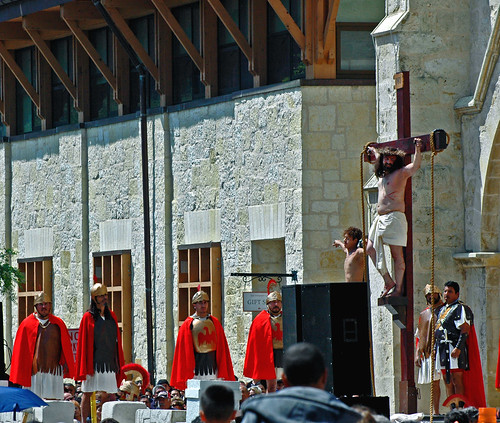 On Friday afternoon, we re-enact the Stations of the Cross. This is an ancient ritual that even the Pope observes. While he does it in fromt of thousands at the Colosseum in Rome, and others will line the Via Delorosa in Jerusalem, we will do it in front of a much smaller crowd in our own church. No candles are lit; no lights are turned on. (In my former home town of San Antonio, they re-enact it every year in an emotional ceremony in front of San Fernando Cathedral.)