Showing posts with label Holy Week. Show all posts

Thursday, March 20, 2008

Maundy Thursday

[The lessons for Maundy Thursday are Exodus 12: 1-14, 1 Corinthians 11: 23-26, and John 13:1-17, 31b-35.]

Tonight, we do several things. We celebrate and commemorate the institution of the Holy Eucharist. In our observance of Holy Week, we turn from the joy and celebration of Jesus’ triumphal entry into Jerusalem on Palm Sunday to the bleak horror of Good Friday. Last Sunday, we joined the crowds 2,000 years ago in Jerusalem, shouting “Hosanna” and waving palm branches. Tonight, we will leave the church in darkness and watch with him in Gethsemane. Tomorrow, we will walk the way of the Cross with him, keep company at the foot of the cross and see him laid in a tomb.

But, first, we will do what Jesus did on his last night. We will join him in the feast he shared with his disciples on that night. When we share this bread and this wine, we join with those countless numbers throughout history who have done this. This is not just a symbolic representation; each time we participate in the Eucharist we participate in his death until he comes again. This food and drink save us from spiritual thirst and hunger, nurturing our souls and freeing us from the bondage of sin and death.

We are saved so we can offer to others the abundant life, the generosity that Jesus offers us. In the words from our Prayer Book, we are called to “offer ourselves, our souls and bodies as a reasonable, holy and living sacrifice.” If Jesus, in his last hours did this for us, can we do anything less for others?

Theologians debate how well Jesus knew the fate that awaited him. I’m sure he did not need his divinity to give him a pretty good idea. He was challenging the Empire of his day—an empire not known for gentility towards those who challenged it—challenging the divinity of the Emperor and calling for a Kingdom of God as opposed to the kingdom of earthly power and force before him. He knew that the end was in sight and a grim, painful end it would be. The Romans would cheerfully line the roads leading into Jerusalem with crosses holding Jews showing what Rome would do to any who would disrupt the Emperor’s peace. This was the time of the Passover, when thousands upon thousands of Jewish pilgrims converged on Jerusalem. And Jesus has spent the week being proclaimed king by the crowds. The Romans would not, could not, tolerate that. Jesus knew where his path would certainly lead him the next day.

What would you do on what you expect to be your last night? Here’s what Jesus did: he held a dinner for his friends. He broke bread with them. And tonight, he calls us to his table, and invites us to remember him when we break bread—every time we do—at the altar, in our homes, wherever we are. We do this in remembrance of him, until he comes again.

But there’s something more: he said of the bread, “This is my body.” The bread and those who share it are the Body of Christ, which was given for the world. I have heard the Eucharist described as, “The Body of Christ receiving the Body of Christ to become more fully the Body of Christ.”

Tomorrow, we will walk in the way of the Cross. Some of us will gather here tomorrow to do that symbolically and others from Pope Benedict to the poorest peasant will do that in other places around the world. But these times of war and economic uncertainty remind us that people walk in the way of the Cross in other ways every day.
  • When we lose a loved one.
  • When we lose cherished relationships.
  • When we’re faced with serious, even life-threatening diseases.
  • When we lose jobs, with all the desperation that can bring in our lives.
  • When we lose homes because of financial problems or disasters.
When that happens we may despair and even cry Jesus’ cry of pain and despair, “My God, My God, why have you forsaken me?” When that happens in our own Gethsemane, our own Golgotha, our own Good Friday, remember, Easter will come. God doesn’t promise that we won’t have to walk that way; after all, his own Son did. The promise is that we won’t be alone on that path and that no enemy, not even the final enemy—death—will ultimately succeed. Remember that Easter makes no sense without Maundy Thursday and Good Friday.

Holy Week

This week is full of symbolism for Christians, even if their religious traditions try to downplay symbolism and formal liturgy.

First, last Sunday, was Palm Sunday, or as the Episcopal Church more formally calls it: "Palm Sunday: The Sunday of the Passion." We began in our Memorial Courtyard blessing palms and hearing the story of Jesus' entry into Jerusalem in procession so obviously reversed from the displays of the triumphal power of Rome. We re-enact the entry by walking carrying palms, singing "All Glory, Laud and Honour", along the front of the churchyard up until we reach the door. Then with shocking suddenness, everything changes. In prayer, we remember that Jesus "went not up to joy but first he suffered pain, and entered not into glory before he was crucified" and the hymn becomes "Ride on! ride on in majesty! In lowly pomp ride on to die;" We say the Passion Gospel in which readers say the parts, with the congregation as the crowd shouting, "Crucify him!" We leave church somewhat uneasily.

Thursday night, we call Maundy Thursday. The name comes from the Latin mandatum or "command" for Jesus' command to his disciples to "love one another as I have loved you." It also commemorates the institution of the Holy Eucharist at the Last Supper. Many churches re-enact Jesus' washing the feet of his disciples as a reminder that to follow Jesus is to serve others, not yourself. At the end of the service, we strip the altar and its surroundings of all furnishings, down to bare wood and we leave the church to begin a vigil in our side chapel, obeying Jesus' call to his disciples that night to "Wait one hour with me."

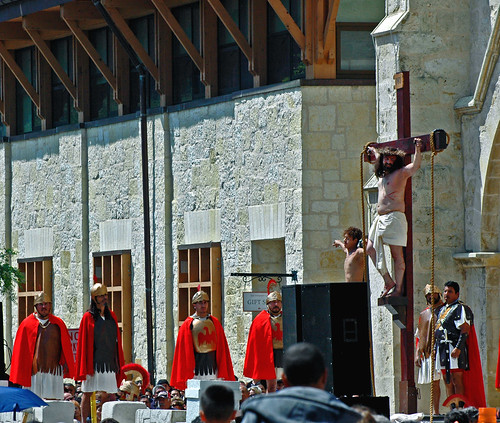
On Friday afternoon, we re-enact the Stations of the Cross. This is an ancient ritual that even the Pope observes. While he does it in fromt of thousands at the Colosseum in Rome, and others will line the Via Delorosa in Jerusalem, we will do it in front of a much smaller crowd in our own church. No candles are lit; no lights are turned on. (In my former home town of San Antonio, they re-enact it every year in an emotional ceremony in front of San Fernando Cathedral.)

Friday evening, we have a sorrowful liturgy which could perhaps be thought of as Jesus' funeral. The church is bare and colorless. When we leave, we leave in silence and darkness, the silence and darkness of the tomb.

Then, in the dark of Saturday evening, everything is changed with the Great Vigil of Easter. We bring the light of Christ back into the darkened church and we sing the Exsultet, an ancient (it dates from between 400 and 600 and is used in the Roman Catholic and Anglican Churches) song of joy and triumph. Following the practice of the early Church, we baptize new Christains and recall our own baptism. We recognize that with Christ's resurrection and victory over death, everything has changed.

Finally (last but not least!), we celebrate again on Sunday morning with a packed church. We may have people that we won't see again until Christmas, but they at least are here this day and we're glad to have them. This may be the end of Holy Week, but it is the beginning of the Great Fifty Days of Easter, and if you want to think of it as a seven-week party, that's fine with us; we do have something glorious to celebrate.